Feb. 1st. A Celtic feast and a Goddess of Nature rather like Gaia but exclusively Irish.
A nice RTE blog about her and the day.
Feb. 2nd. The day that follows is a purely Christian Feast, The Presentation of the Lord: when the child Jesus was taken to the temple with an offering of two doves and presented or shown to God his father.
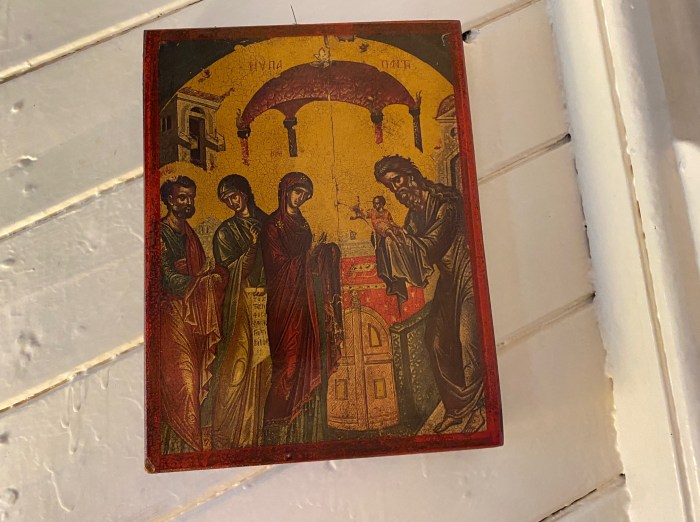
I bought this Ikon many years ago on a Greek Island as a present for my father, Daniel, who died in 1988.
After my mother died my father and I became closer than before and I thought the ikon represented this transition from the mother to the father symbolically very well. The child Jesus is held in the picture by Symeon, a holy and pious man, as Luke tells us, in Luke 2, v. 25. To the left is Jesus’s mother Mary and behind her holding a scroll is Anna, a prophetess and behind her is Joseph. Joseph, as the Greek Orthodox priest told me as I visited his church (the Church of the Presentation): “Joseph, is of course not the child’s father”; he is holding the two doves to be offered as a sacrifice to God. Above the canopy presides the Dove as symbol of the Holy Spirit.
The icon has hung on our wall for nearly thirty years now and we light a candle by it each 2nd. of February. Apart from reminding me of the new Testament story it reminds me of Washburn’s account of Freud’s Oedipus Stage in child development:
the child “…undergoes what psychoanalysis calls the change of object, the process by which the child weans itself from the radical intimacy with the pre oedipal mother as primary love object and commits itself unconditionally to the oedipal father as primary authority figure.”
(Washburn (2003) page 17)
I don’t really like these mythological references used in psychoanalysis, they are often superficial parallels; for example the Oedipus myth differs in so many ways from the developmental stage as Freud called it and as Washburn describes it. Narcissus is also much maligned in the psychoanalytic model: in the Ovid account of the myth his fate is sealed because of Nemesis’s curse, given after she heard the prayers of one of his unrequited male lovers and so as Goddess of Vengeance she decided to punish him. Perhaps I am open to the same criticism here with my linking the Christian story and a psychological event. I do think, however, that it fits the bill very well. And I am not suggesting therefore that one might refer to a “Presentation Stage” or anything as silly as that. To return to the Luke version; Symeon, when he takes the child in his arms, prays, giving thanks to God, in what has become known as the “Song of Symeon” or “The Nunc Dimittus”: the Latin name being the first two words of the prayer “Now thou dost dismiss thy servant O Lord….” It is said in the Office of Compline every night by monks and nuns.
It is interesting to note that many of these Christian Feast Days were introduced to overshadow and discourage the Pagan Days of Spirituality: so The Presentation is to overshadow the Celtic Pagan Feast of Imbolc, just as All Saints Day on the 1st of November overshadows the Celtic feast of Samhain on the 31st of October. https://www.newgrange.com/samhain.htm. There is of course a thematic relationship between them, in the later All Saints followed by All Souls connects with the perceived gap between the World of the Living and the World of the Dead that occurs in the Celtic belief and The Presentation also called Candlemas connects with the beginning of Spring and the growing daylight hours in the Celtic belief system and Christ as “the light to enlighten the Gentiles” which is part of Symeon’s prayer. Sadly, for me, this hiding the one with the other, the overshadowing as I have called it, doesn’t quite work since the one reminds me of the other; particularly since I live in a Celtic Nation that still holds some of the old religion sacred.
Washburn, Michael,(2003). “Embodied Spirituality in a Sacred World”: Albany, State University of New York Press.
 The Hug of Gaia